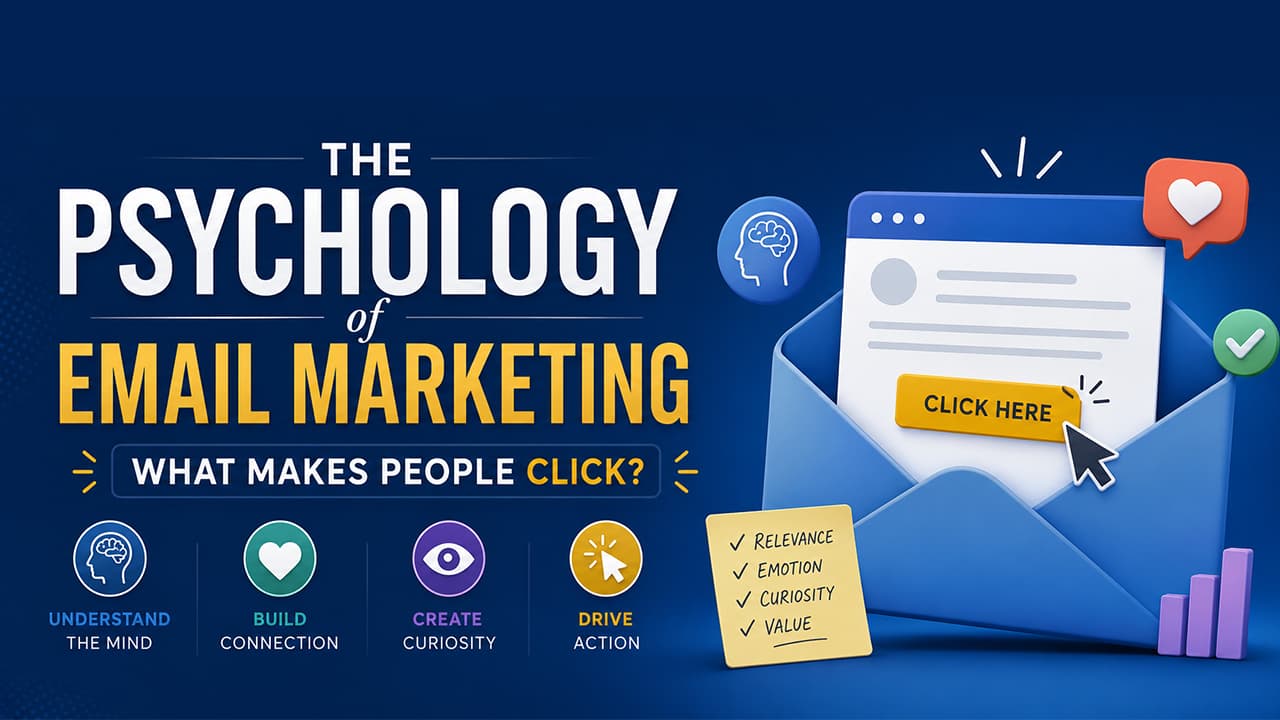
Every day, over 300 billion emails land in inboxes around the world. Most are ignored. Some are deleted without a second glance. But a precious few — the ones that understand how the human mind actually works — get opened, read, and acted upon. What separates the clicked from the discarded? It's rarely about design alone, or even the offer. It comes down to psychology.
The most effective email marketers aren't just copywriters or designers — they're behavioural scientists in disguise. They understand that every subject line, every CTA button, every countdown timer is a nudge aimed at the ancient, instinct-driven part of the brain that decides what matters. In this post, we'll break down the core psychological principles that power high-performing email campaigns — and show you exactly how to put them to work.
01
The Power of Scarcity: Act Now, or Miss Out
Scarcity is one of the oldest psychological levers in marketing — and it works because of a simple cognitive truth: we value things more when they're rare. When your brain perceives that something might run out, it shifts into urgency mode. Rational deliberation takes a back seat. The desire to secure the resource kicks in.
In email marketing, scarcity shows up as limited stock warnings ("Only 3 left!"), time-bound offers, and exclusive access windows. These aren't gimmicks — they're rooted in the economics of loss aversion. Nobel-winning psychologist Daniel Kahneman showed that losses feel roughly twice as powerful as equivalent gains. Telling a subscriber what they stand to lose by not clicking is far more motivating than telling them what they stand to gain.
Quick Win Use real scarcity, not manufactured. Readers are savvy — if the "48-hour sale" recurs every week, it loses all power. Genuine urgency converts; fake urgency erodes trust.
02
Social Proof: Everyone's Doing It
Humans are profoundly social creatures. When we're uncertain about a decision, we instinctively look to others for guidance. This is social proof — the psychological shortcut that says, "If thousands of people chose this, it's probably a safe bet."
In emails, social proof can take many forms: customer review snippets, star ratings, "Join 50,000 subscribers" headlines, user-generated photos, or even a simple "bestseller" badge. The key is specificity — "Loved by 12,847 customers" feels far more credible than a vague "hugely popular." Numbers signal real evidence. And evidence dissolves hesitation.
"If it worked for people like me, it'll work for me too."
This is why case studies, testimonials, and community counts are such potent email elements. They transform your claim from self-promotion into third-party endorsement — which the brain trusts exponentially more.
03
FOMO: Fear of Missing Out
FOMO is the 21st century's most powerful marketing emotion — and email is its natural habitat. It's the nagging anxiety that life (or in this case, a deal, an event, an opportunity) is happening somewhere else, and you're not part of it. Unlike simple scarcity, which focuses on supply, FOMO taps into belonging and social identity.
Emails that leverage FOMO don't just say "this expires soon." They paint a picture of the world after the opportunity passes — the regret, the gap, the experience you didn't have. Phrases like "Don't be the only one who missed this," early-bird exclusives, and invitation-only campaigns all trigger this response. When your subscriber imagines their peers enjoying something they opted out of, the desire to act becomes visceral.
Key Insight The difference between FOMO and scarcity: scarcity is about the product running out; FOMO is about the subscriber being left behind. Both are powerful — but FOMO hits deeper, because it's personal.
04
Personalization: Make It About Them
Nothing cuts through inbox noise faster than your own name — or the sense that a message was written specifically for you. The brain has a remarkable ability to filter out irrelevant information; personalisation bypasses that filter entirely. It signals: this is relevant to you, right now.
Modern email personalization goes far beyond the "[First Name]" token. Behavioural data — what a subscriber browsed, purchased, clicked, or abandoned — allows marketers to deliver messages that feel almost psychic. A cart abandonment email that names the exact product left behind. A re-engagement campaign triggered by a gap in activity. A birthday offer with a discount that lands on the right day. Each of these works because the brain is wired to pay attention to information that feels personally relevant.
Research consistently shows that personalised emails deliver significantly higher transaction rates than generic ones. The reason is simple: relevance reduces friction. When the content already matches what you care about, the gap between "reading" and "clicking" becomes very small indeed.
05
Visual Cues: Guide the Eye, Guide the Click
The human eye doesn't read emails the way it reads books — it scans, jumps, and gravitates toward contrast and visual hierarchy. Understanding how eyes move through an email isn't a design nicety; it's a conversion strategy.
Research using eye-tracking studies shows predictable scanning patterns — often F-shaped or Z-shaped — that determine which parts of an email get absorbed and which get skipped entirely. Smart email designers work with these patterns rather than against them. A bold CTA button placed at the end of a visual flow. Directional cues — an arrow, a person's gaze, a pointing hand — that physically direct attention toward the action you want taken. White space used strategically to make the most important element impossible to miss.
Colour psychology plays a role too. Warm accent colours (reds, oranges) create urgency. Cool tones (blues, greens) signal trust. High contrast between the CTA and background increases click rates not because it looks good, but because the brain's attentional system can't ignore it.
Final Thoughts
Great email marketing isn't about tricking anyone. It's about understanding the timeless architecture of human decision-making — the fears, desires, social instincts, and cognitive shortcuts that have shaped behaviour long before inboxes existed — and using that understanding to communicate more effectively.
Scarcity creates urgency. Social proof builds trust. FOMO stirs emotion. Personalization signals relevance. The Zeigarnik effect generates curiosity. Visual hierarchy directs action. Used thoughtfully and honestly, these principles don't just improve click rates — they make your emails genuinely worth reading. And in a world drowning in noise, that might be the most powerful competitive advantage of all.